Ta'ãnga:Titan multi spectral overlay.jpg


| Mombe'uanga |
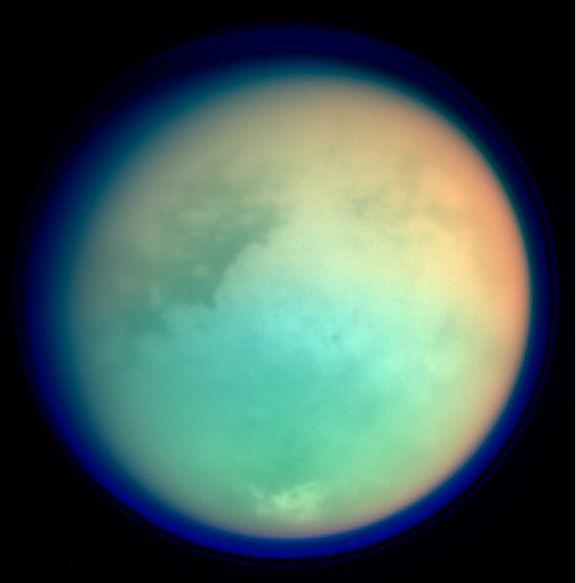
English: Photograph of the Saturn moon Titan in False Color, taken by the Cassini space probe with ultraviolet and infrared camera on 26 Oct. 2004.
Original caption released with the image: "This image shows Titan in ultraviolet and infrared wavelengths. It was taken by Cassini's imaging science subsystem on Oct. 26, 2004, and is constructed from four images acquired through different color filters. Red and green colors represent infrared wavelengths and show areas where atmospheric methane absorbs light. These colors reveal a brighter (redder) northern hemisphere. Blue represents ultraviolet wavelengths and shows the high atmosphere and detached hazes. Titan has a gigantic atmosphere, extending hundreds of kilometers above the surface. The sharp variations in brightness on Titan's surface (and clouds near the south pole) are apparent at infrared wavelengths. The image scale of this picture is 6.4 kilometers (4 miles) per pixel. The Cassini-Huygens mission is a cooperative project of NASA, the European Space Agency and the Italian Space Agency. The Jet Propulsion Laboratory, a division of the California Institute of Technology in Pasadena, manages the Cassini-Huygens mission for NASA's Office of Space Science, Washington, D.C. The Cassini orbiter and its two onboard cameras, were designed, developed and assembled at JPL. The imaging team is based at the Space Science Institute, Boulder, Colo."Deutsch: Saturnmond Titan; der Bereich der Infrarotstrahlung und der der Ultraviolettstrahlung sind durch unterschiedliche Farbfilter sichtbar gemacht.
Rötliche und grünliche Farben repräsentieren den Infrarotbereich und indikieren Areale, in denen in der Atmosphäre enthaltenes Methan Licht absorbiert; bläuliche Farbe repräsentiert den Ultraviolettbereich und indikiert die obere Atmosphäre sowie die getrennten Schichten der Dunstschicht. Das Bild verwendet vier bei Cassinis Vorbeiflug am 26. Oktober 2004 durch unterschiedliche Farbfilter gemachte Aufnahmen.Norsk nynorsk: Bilete av Titan teken av Cassini-romsonden med ultrafiolett og infraraudt kamera den 26. oktober 2004. |
| Arange | |
| Moõgui oguenohẽ |
NASA planetary photojournal, prepared by Alfred McEwen |
| Apohára | NASA/JPL/Space Science Institute |
| Permiso (Reutilización de este archivo) |
Copyright information from http://www.jpl.nasa.gov/images/policy/index.cfm - Unless otherwise noted, images and video on JPL public web sites (public sites ending with a jpl.nasa.gov address) may be used for any purpose without prior permission [...] |

|
Este archivo es de dominio público porque fue creado por la NASA. Las políticas sobre copyright de la NASA estipulan que «el material de la NASA no está protegido con copyright a menos que se indique lo contrario». (Políticas sobre copyright de la NASA o Políticas sobre la utilización de imágenes del Jet Propulsion Laboratory). |  |
 |
Advertencias:
|
Marandurenda rembiasakue
Ejopy peteĩ ára/aravo rehe rehecha hag̃ua pe marandurenda ojehechaukaháicha upe jave.
| Ára/Aravo | Michĩháicha | Tuichakue | Puruhára | Jehaimombyky | |
|---|---|---|---|---|---|
| ko’ag̃agua | 07:52 3 jasyteĩ 2018 | | 576 × 576 (20 kB) | wikimediacommons>User-duck | Make square using CropTool with lossless mode. |
Marandurenda jeporu
La siguiente página usa este archivo:
